Projects
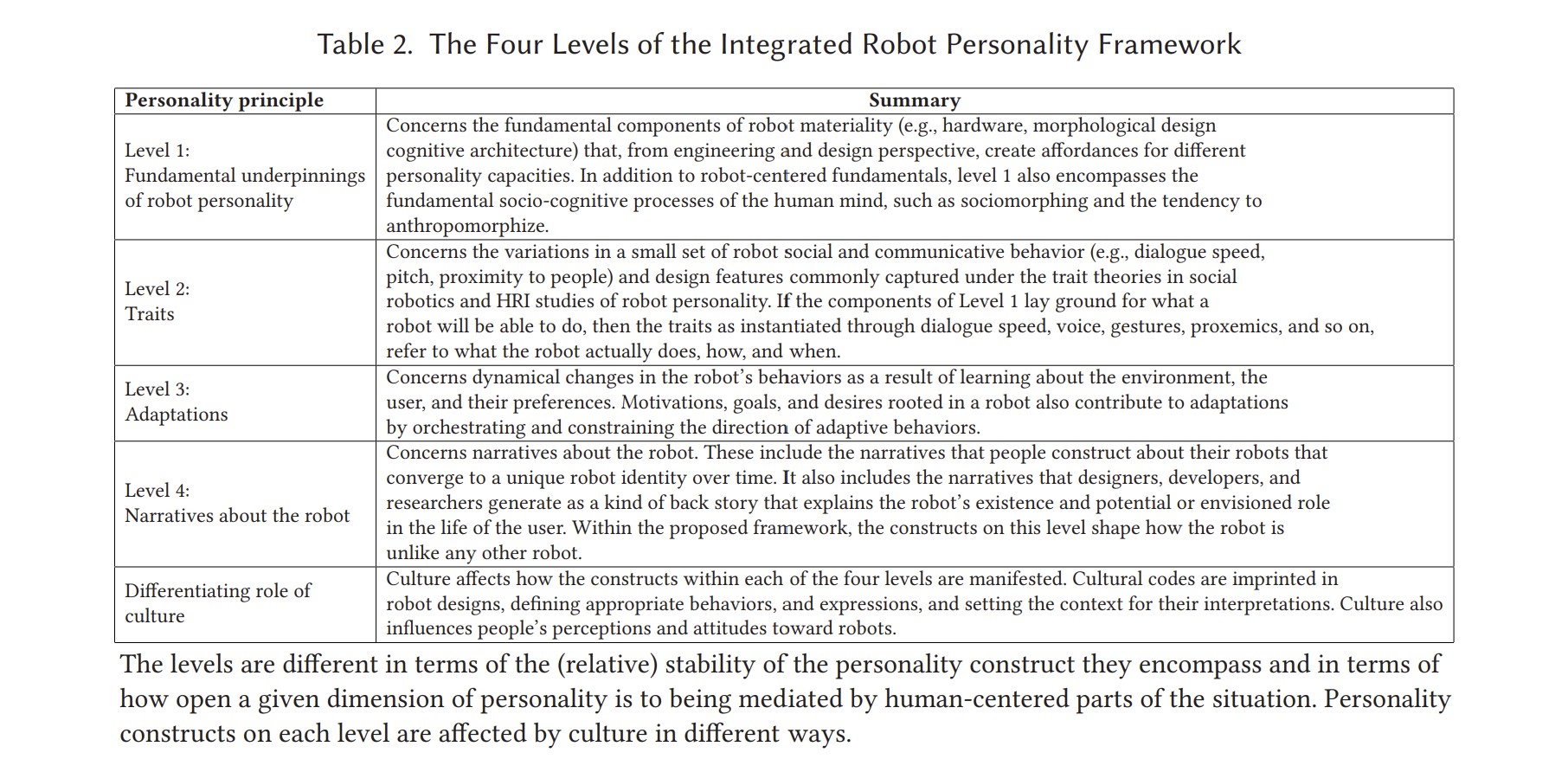
This small project was a theoretical exploration within the early stages of my PhD, focusing on the complex concept of robot personality. In this project, I moved beyond trait-based models as the dominant approach to robot personality research to propose an Integrative Framework for Robot Personality. This theoretical framework encompasses four levels: robot materiality (hardware, software, and design features), behavioral traits (static cues), dynamic adaptations (learned behaviors over time), and the narratives constructed by humans about robots.
My aim in this project was to showcase that robot personality emerges from the interaction between these levels, the robot’s task, context, and human factors, rather than being an inherent property or mere attribution.
Related publications:
- Dobrosovestnova, Anna, Reinboth, Tim, and Weiss, Astrid (2024). Towards an Integrative Framework for Robot Personality Research. In: J. Hum.-Robot Interact. 13(1), pp. 8:1–8:22.
- Dobrosovestnova, Anna (2022). Challenging Current Approaches to Emotions in Human-Robot Interaction. In: ACM 2023 Conference on Human Factors in Computing Systems (CHI). Future of Emotions Workshop.
- Dobrosovestnova, Anna and Weiss, Astrid. (2021). Exploring Long-Term Impact of Embodiment on Socially Interactive Robot Identity. In 2021 ACM/IEEE International Conference on Human-Robot Interaction. Workshop Robo-Identity: Exploring artificial identity and multi-embodiment.
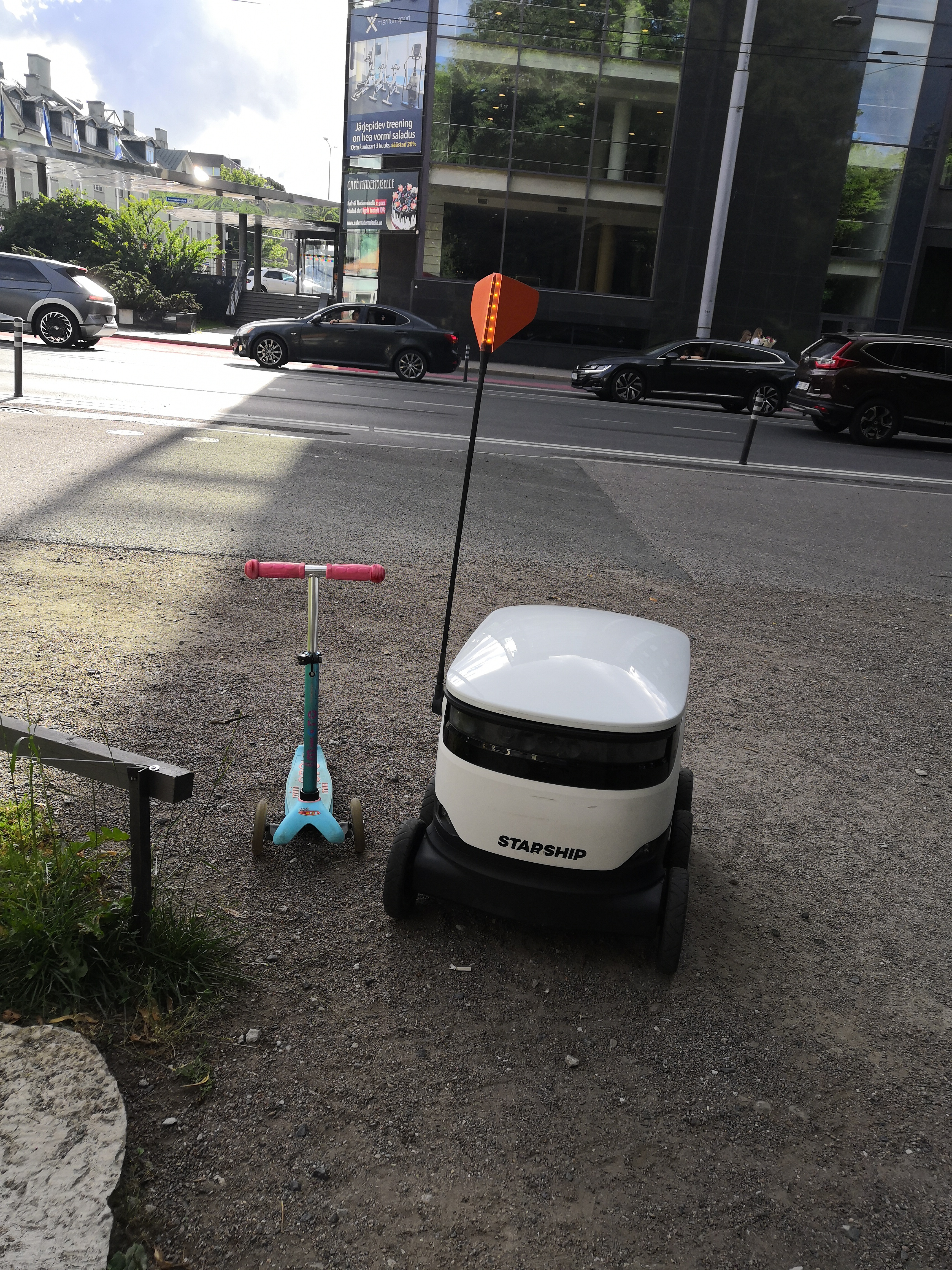
My PhD thesis explored human-robot interactions in public spaces, using Starship delivery robots as a case study to understand how these technologies fit into urban communities. I used methods like ethnographic observations, interviews, online content analysis, and surveys to examine how residents interacted with robots in their daily lives. I examined instances of voluntary assistance—how and why people help robots when they appear stuck or in need, and whether such assistance is framed as care, work, or an unnecessary dependency. I explored the role of national and individual identity in shaping perceptions of robots, highlighting how cultural narratives influence whether robots are seen as purposeful or even a source of local pride. Additionally, I investigated how factors like perceived politeness and cuteness contribute to a robot’s social acceptance, shaping the ways people negotiate their presence in public spaces.
Related publications:
- Dobrosovestnova, Anna, Babel, Franziska, and Pelikan, Hannah (2025). Beyond the User: Mapping Subject Positions for Robots in Public Spaces. [forthcoming] In: 2025 20th ACM/IEEE International Conference on Human-Robot Interaction (HRI). Melbourne, Australia.
- Dobrosovestnova, Anna and Vetter, Ralf (2024). Identity and Community Matter(s): Exploring Socio-cultural Dimensions of Functional Service Robots Acceptance in Public Spaces. In: 2024 33rd IEEE International Conference on Robot and Human Interactive Communication (ROMAN). IEEE, pp. 2139–2146.
- Dobrosovestnova, Anna, Lee, Hee Rin, Ljungblad, Sara, Gamboa, Mafalda, Gosnall, Toby, and Mansouri, Masoumeh (2024). Ethnography in HRI: Embodied, Embedded, Messy and Everyday. In: Companion of the 2024 ACM/IEEE International Conference on Human-Robot Interaction. New York, NY, USA: Association for Computing Machinery, pp. 1314–1316.
- Dobrosovestnova, Anna, Vetter, Ralf, and Weiss, Astrid (2024). Attitudes towards Social Robots (ASOR): Revisiting the Scale with Four Types of Robots. In: Companion of the 2024 ACM/IEEE International Conference on Human-Robot Interaction. New York, NY, USA: Association for Computing Machinery, pp. 402– 406.
- Dobrosovestnova, Anna and Weiss, Astrid (2024). What we Learn on the Streets: Situated Human-robot Interactions from an Industry Perspective. In: Companion of the 2024 ACM/IEEE International Conference on Human-Robot Interaction. New York, NY, USA: Association for Computing Machinery, pp. 407–411.
- Dobrosovestnova, Anna and Reinboth, Tim (2023). Helping-as-Work and Helpingas- Care: Mapping Ambiguities of Helping Commercial Delivery Robots. In: Social Robots in Social Institutions: Proceedings of Robophilosophy 2022. IOS Press, pp. 239–248.
- Dobrosovestnova, Anna, de Pagter, Jesse, and Weiss, Astrid (2023). Borrowing, Poking and Entangling: In Search of Shared Spaces Between Science and Technology Studies and Human-Robot Interaction. In: Companion of the 2023 ACM/IEEE International Conference on Human-Robot Interaction. New York, NY, USA: Association for Computing Machinery, pp. 21–29.
- Dobrosovestnova, Anna, Schwaninger, Isabel, and Weiss, Astrid (2022). With a Little Help of Humans: An Exploratory Study of Delivery Robots Stuck in Snow. In: 2022 31st IEEE International Conference on Robot and Human Interactive Communication (RO-MAN). IEEE, pp. 1023–1029.
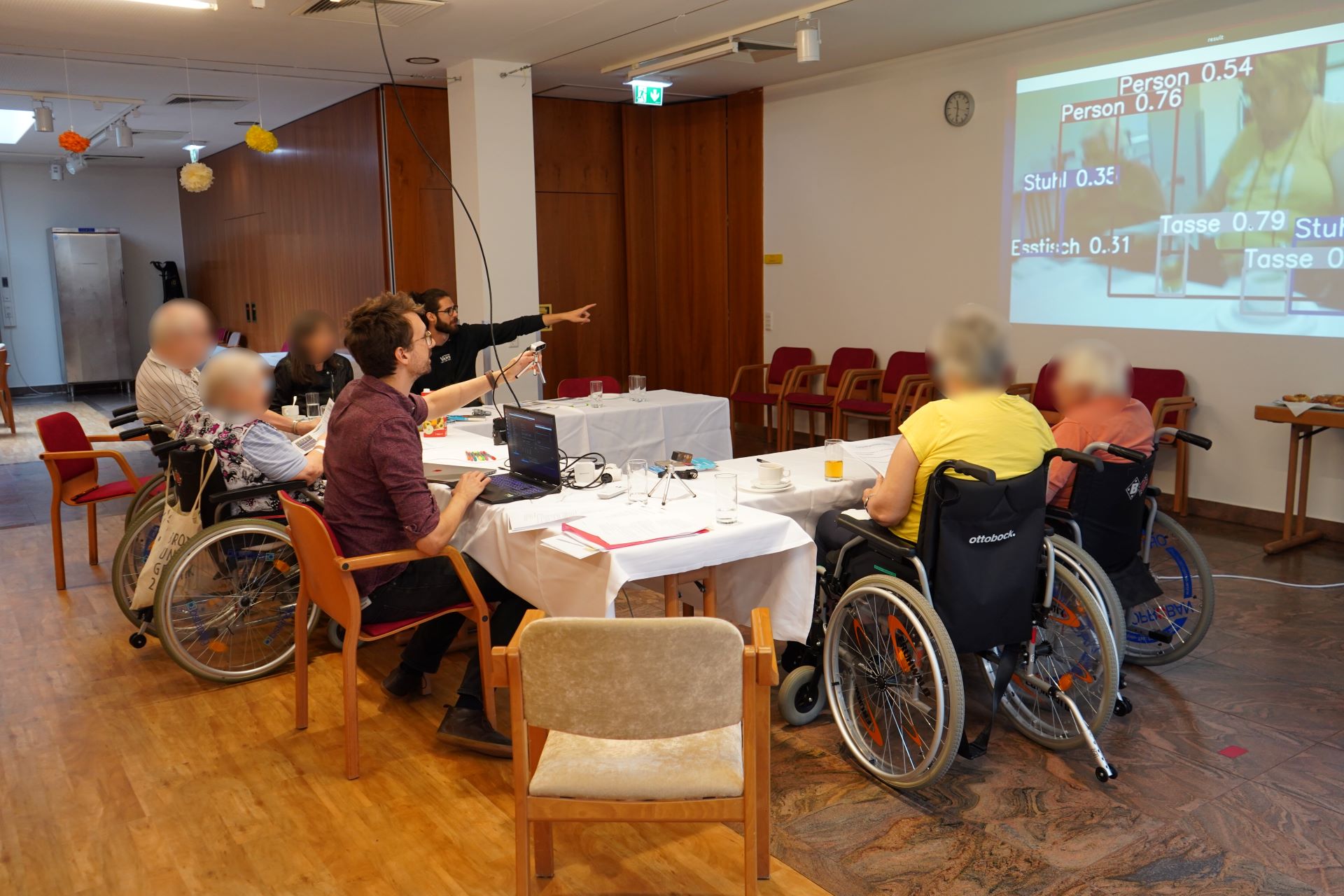
Caring Robots // Robotic Care is a transdisciplinary research project by TU Wien, IT:U Interdisciplinary Transformation University Austria, Caritas Wien, and Technisches Museum Wien that reimagines the role of robotic technology in elderly care. Rather than focusing on what robots could do, we ask what they should do within the complex socio-technical realities of care work. Through a participatory design process, we involve caregivers, care recipients, care organization partners, and other stakeholders to develop robotic solutions that are useful, safe, meaningful, and wanted. Our goal is to create desirable futures for care—going beyond mere technological feasibility to ensure that innovations align with ethical considerations, social values, and the real needs of those involved.
In my role as a project assistant, I contribute to shaping the fieldwork, conducting qualitative data analysis, and co-authoring publications.
Project website: https://www.caringrobots.eu/
Related publications:
- Vetter, Ralf, Dobrosovestnova, Anna, Frijns, Helena Anna, Vogel, Laura, Brunnmayr, Katharina, and Frauenberger, Christopher (2024). From Care Practices to Speculative Vignettes–Design Considerations for Robots in Good Care. In: Frontiers in Robotics and AI 11:1347367.